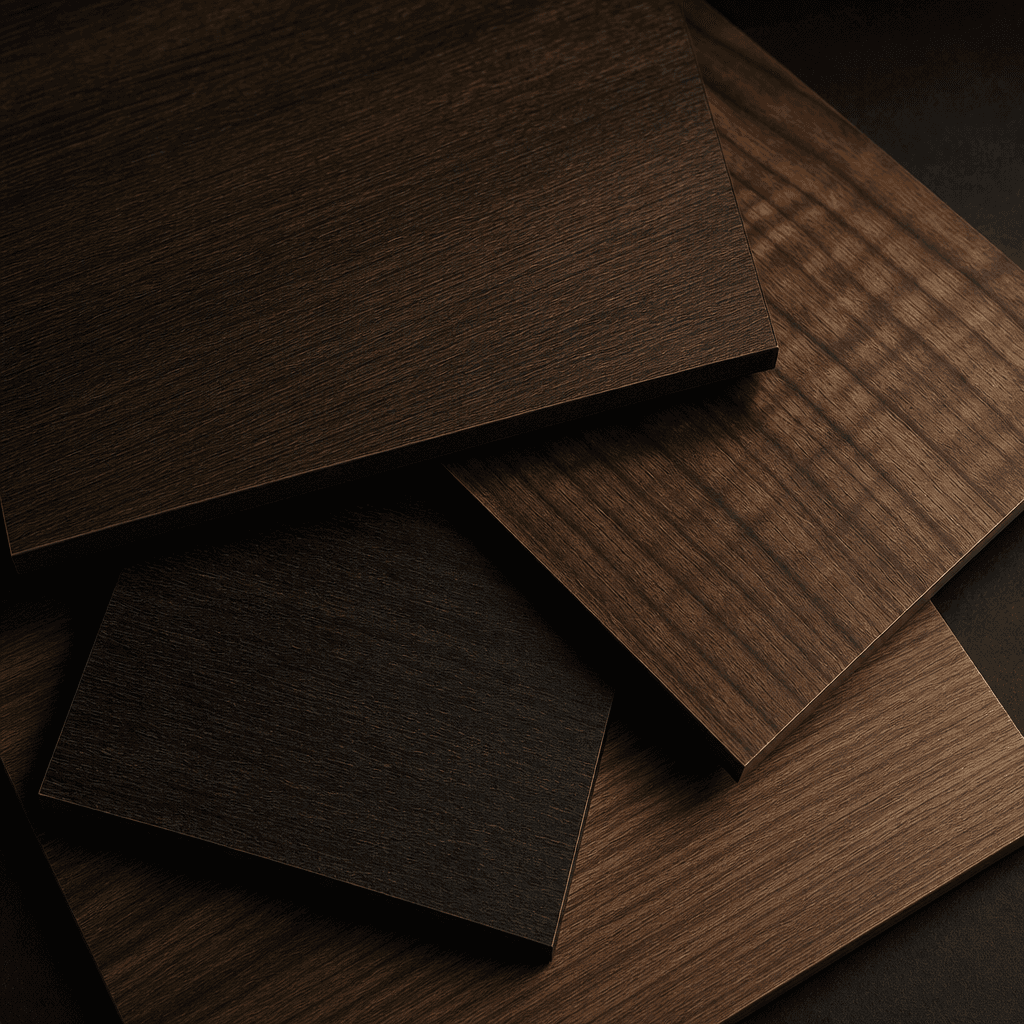
In brief
- 011 mm for shutters and high-touch faces, 0.8 mm for lighter vertical use.
- 02Wear resistance comes from the grade, not the thickness alone.
- 03Rounded edges need post-forming grade laminate.
For most Indian furniture, 1 mm decorative laminate is the usual choice for surfaces people see and handle, 0.8 mm is a common lighter option for vertical faces, and thinner liner laminates go inside cabinets and on the backs of panels. Thickness is only half the decision, though: the grade and the finish decide how a laminate wears, cleans and looks.
What is decorative laminate made of?
High-pressure laminate is built from layers of kraft paper impregnated with thermosetting resin, topped by a printed or coloured decorative paper impregnated with melamine resin, all pressed together under heat and high pressure. The decorative layer gives the colour and the finish; the kraft layers give the sheet its body and thickness.
0.8 mm vs 1 mm: what changes?
The extra thickness is mostly extra kraft core. A 1 mm sheet is a little stiffer, feels more solid and is less prone to chipping at edges and corners, which is why it is preferred for shutters, tabletops and worktops. A 0.8 mm sheet is lighter and easier to work, and is widely used for vertical panels and less-handled areas.
What thickness does not settle is surface wear. In the European EN 438 classification, the same 0.8 mm sheet can be made as a vertical grade or a horizontal grade, and the horizontal grade has to meet a markedly higher wear-resistance requirement. Ask for the grade as well as the thickness.
| Type | Typical thickness | Where it goes |
|---|---|---|
| Decorative laminate | About 1 mm | Shutters, tabletops, worktops, high-touch faces |
| Decorative laminate, lighter | About 0.8 mm | Vertical panels, wardrobe interiors, low-wear faces |
| Post-forming grade | Usually thinner than the standard grade | Rounded worktop edges, curved fronts |
| Liner or backer | Typically 0.6 to 0.8 mm | Cabinet interiors, backs of panels for balance |
| Compact laminate | 2 mm and above, self-supporting | Washroom cubicles, lockers, hard-wearing tops |
Why liners and balancing matter
A board laminated on one face only can bow, because the laminate and the board respond differently as humidity changes. A liner or backer on the opposite face balances the panel and helps it stay flat. Liners are thinner, usually come in plain colours or a simple texture, and are meant for surfaces that are seen but not heavily used, such as the inside of a wardrobe.
Matte, gloss, suede or textured?
- Matte: low sheen and calm. It tends to hide fine scratches and smudges better than gloss, which makes it easy to live with.
- Gloss and high gloss: bright and reflective, with strong colour, but it shows fingerprints, smears and fine scratches more readily.
- Suede: a soft, fine texture with a low sheen, and one of the most common everyday finishes in Indian furniture.
- Textured: wood-grain, stone, fabric or linen embossing you can feel. Synchronised textures follow the printed grain for a more convincing wood look.
Finish affects cleaning as well as looks. Deep textures can hold dirt in their grooves, so near a hob or sink choose a texture that wipes clean easily.
What is post-forming laminate?
Post-forming grade laminate can be heated and bent around a radius after pressing, which is how rounded worktop edges and curved fronts are made without a visible joint. It has to pass a formability test around a specified radius. Standard grades are not made to bend this way and may crack if forced. Post-forming also needs the right heating equipment and an experienced fabricator.
Many technical sheets use the EN 438 grade codes, which are easy to read once you know them:
- First letter: H for horizontal surfaces, V for vertical ones.
- Second letter: G for general purpose.
- Third letter: S for standard, P for post-forming, F for flame retardant.
- So HGP is a horizontal, general-purpose, post-forming laminate, and VGF a vertical, flame-retardant one.
Which standard covers laminates in India?
Decorative laminates are covered by IS 2046, revised in 2025 as a multi-part standard based on the international ISO 4586 series. Part 3 deals with laminates under 2 mm thick that are bonded to a substrate, which is what most furniture laminate is, and Part 4 covers compact laminates 2 mm and thicker. A technical sheet should tell you the standard, the grade and the thickness.
Common questions
- Which is better, 0.8 mm or 1 mm laminate?
- For shutters, tabletops and surfaces handled every day, 1 mm is the usual choice because it is stiffer and less prone to edge chipping. 0.8 mm suits vertical panels, wardrobe interiors and lighter-use faces. Thickness is not the whole story, since wear resistance depends on the laminate's grade, so ask for the grade and finish as well as the thickness.
- What is liner laminate used for?
- Liner laminate is a thinner, simpler laminate, typically around 0.6 to 0.8 mm, used inside cabinets and wardrobes and on the back face of panels. Laminating both faces of a board balances it, which helps it stay flat as humidity changes. Liners are not designed for surfaces that take daily wear, so use decorative laminate on visible, high-touch faces.
- Can any laminate be used for rounded worktop edges?
- No. Rounded edges need post-forming grade laminate, which is made to be heated and bent around a radius without cracking. In the EN 438 system these grades carry a P in their code, such as HGP or VGP. Standard grades are not designed to bend, and post-forming also needs proper heating equipment and an experienced fabricator.
- Is matte or gloss laminate better for a kitchen?
- Both can work. Matte and suede finishes are easier to live with day to day because they tend to hide fine scratches and smudges. Gloss looks bright and reflective but shows fingerprints and fine scratches more readily, so it suits owners who are happy to wipe it often. Whichever you choose, prefer a finish that cleans easily near the hob and sink.