In brief
- 01Every type is real wood; they differ in how the leaf is treated after slicing.
- 02Natural and figured veneers are unique; reconstituted veneer is repeatable.
- 03Dyed and smoked veneers change colour; backed veneers add flexibility.
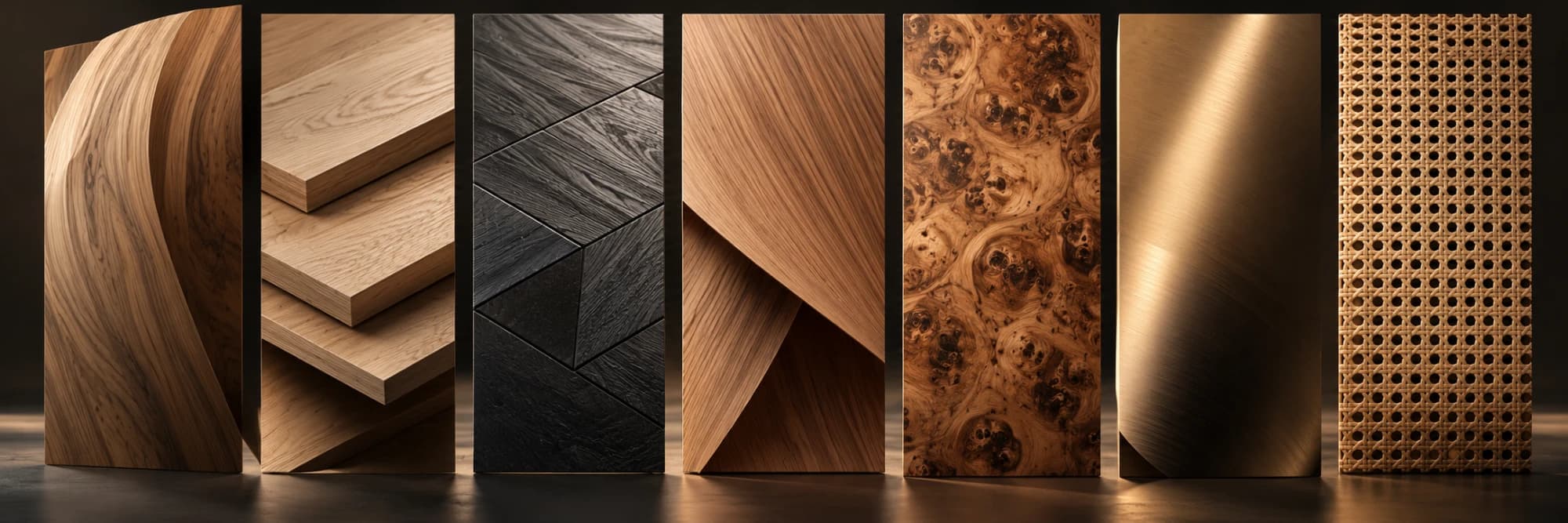
Wood veneer comes in a handful of main types: natural veneer sliced straight from the log, reconstituted or engineered veneer rebuilt from dyed leaves, dyed veneer, smoked or fumed veneer, figured veneers such as burl, and backed veneers made flexible with paper or a second wood ply. All of them are real wood. What separates them is how the leaf is treated after slicing, and that decides its colour, its consistency and where it works best.
Natural veneer
A thin leaf sliced or peeled from a log and left in its own colour. Every leaf carries the grain of that particular tree, and the leaves are kept in the order they came off the log so they can be matched across a panel or a wall. Natural veneer is the reference point for everything else on this list. How the log is cut, whether rotary, crown or quarter, changes the figure almost as much as the species does.
Reconstituted or engineered veneer
Made from fast-growing timber. The leaves are dyed, glued together into a block and sliced again, so the glue lines between the original leaves become the new 'grain'. The pattern repeats closely from one sheet to the next, and it can imitate scarce species or produce designs that never grew in a forest. It is still wood, not a print, and it suits large areas where the surface must look the same from end to end.
Dyed veneer
Natural leaves coloured with dye, so the colour moves into the wood fibres rather than sitting on top like a stain. Dyeing evens out the colour differences between parts of a log, and it opens up colours wood does not grow in, from soft greys to deep blacks. The grain and texture still show through. Dyed wood can shift in colour under strong sunlight, as many natural tones also do, so it is best kept out of constant direct sun.
Smoked or fumed veneer
The leaves are placed in a sealed chamber with ammonia vapour. The ammonia reacts with the tannins already present in the wood and darkens it, so the new colour comes from a chemical change inside the leaf rather than from an added dye. Species rich in tannin, oak above all, respond strongly and can move from warm brown to almost black depending on how long they are treated. Low-tannin species change much less. Smoked oak is the example most people know.
Figured veneer: burl, crotch and more
Figure is the pattern created by unusual grain, as opposed to colour. Burls come from rounded outgrowths on a tree and show clusters of tiny knots. Crotch veneer comes from the point where a branch meets the trunk and shows a feather or flame. Fiddleback, quilted and bird's eye figures ripple or spot across the grain. These leaves are smaller, more fragile and more varied than plain stock, and they have a guide of their own.
Backed and flexible veneer
A raw leaf has no backing and can be used either way up. A backed veneer has a thin layer of paper, fleece or a second wood ply bonded behind it. The backing holds the leaf together, stops it splitting along the grain, and lets it bend round columns, curved fronts and rounded edges. Paper-backed and wood-on-wood, where a second ply runs across the grain of the face, are the common forms. Which one suits depends on the radius and the adhesive, so confirm it with whoever is pressing or fixing the veneer. The decorative face can be any of the types above.
The types side by side
| Type | How it is made | What it looks like | Often chosen for |
|---|---|---|---|
| Natural | Sliced or peeled from a log, colour untouched | Unique grain that varies leaf to leaf | Feature walls, furniture, matched panelling |
| Reconstituted | Dyed leaves glued into a block and sliced again | An even, repeatable pattern | Large areas that must look consistent |
| Dyed | Natural leaves coloured with dye | Real grain under a chosen colour | Contemporary schemes, colours wood lacks |
| Smoked or fumed | Ammonia vapour reacts with tannins in the wood | Deeper browns, up to near black | Darker oak tones without a surface stain |
| Figured | Cut from burls, forks or unusual grain | Swirls, eyes, flames or ripples | Smaller statement surfaces |
| Backed | Paper, fleece or a wood ply bonded behind the leaf | The same as its face | Curves, columns and edges |
How to choose
- Start with the look. Unique grain points to natural or figured veneer; strict consistency points to reconstituted.
- For a colour wood does not have, look at dyed veneer. For darker oak without a painted-on stain, look at smoked.
- For curves, ask for a backed veneer rather than forcing a raw leaf round a bend.
- Whatever the type, approve a physical sample from the batch you will actually receive.
Common questions
- What are the main types of wood veneer?
- The main types are natural veneer, sliced straight from the log; reconstituted or engineered veneer, rebuilt from dyed leaves for a repeatable pattern; dyed veneer; smoked or fumed veneer, darkened with ammonia vapour; figured veneers such as burl and crotch; and backed veneers with paper or a wood ply behind the leaf for flexibility. All are real wood. They differ in how the leaf is treated after slicing.
- What is smoked veneer?
- Smoked veneer, also called fumed veneer, is natural veneer darkened by exposure to ammonia vapour in a sealed chamber. The ammonia reacts with tannins already in the wood, so the colour changes within the leaf rather than as a surface stain. High-tannin species such as oak darken the most, from warm brown to almost black, depending on how long they are treated.
- Is dyed veneer real wood?
- Yes. Dyed veneer is a natural wood leaf that has been coloured with dye, so the grain and texture of the timber still show through. Dyeing evens out colour variation and makes possible colours that wood does not grow in. Like many coloured finishes, dyed wood can shift under strong sunlight over time, so keep it away from constant direct sun.
- Which type of veneer is best for curved surfaces?
- Backed veneer is usually the better choice for curves. A thin layer of paper, fleece or a cross-grained wood ply bonded behind the leaf holds it together and lets it bend without splitting along the grain. The right backing depends on the radius and the adhesive, so confirm the specification with whoever is pressing or fixing the veneer before you order.